Sunset Flicks 2026 Program Notes
Friday, August 28, 2026
Bay Street, Bellingham, WA
Tonight's films
-
Fishing (1921)
Cartoon. 8 minutes
-
Scenes from Gold Rush Seattle (1897)
Actualities. 4 minutes
-
Bad Buck of Santa Ynez (1915)
Western. 29 minutes
-
The Frogs Who Wanted a King (1917)
Animated novelty. 9 minutes
-
The Nursemaids' Strike (1907)
Satire. 12 minutes
-
Big Business (1929)
Comedy. 19 minutes
Behind the Scenes
-
Fishing (1921)
Cartoon. 8 minutes
-
Scenes from Gold Rush Seattle (1897)
Actualities. 4 minutes
-
Bad Buck of Santa Ynez (1915)
Western. 29 minutes
-
The Frogs Who Wanted a King (1917)
Animated novelty. 9 minutes
-
The Nursemaids' Strike (1907)
Satire. 12 minutes
-
Big Business (1929)
Comedy. 19 minutes
-
About the Composers
Learn about the creators of tonight's scores
-
About the Musicians
The performers bringing the scores to life
-
About the Programmer
The curator of tonight's films
-
Tonight's Sponsoring Organizations
The folks who made tonight possible
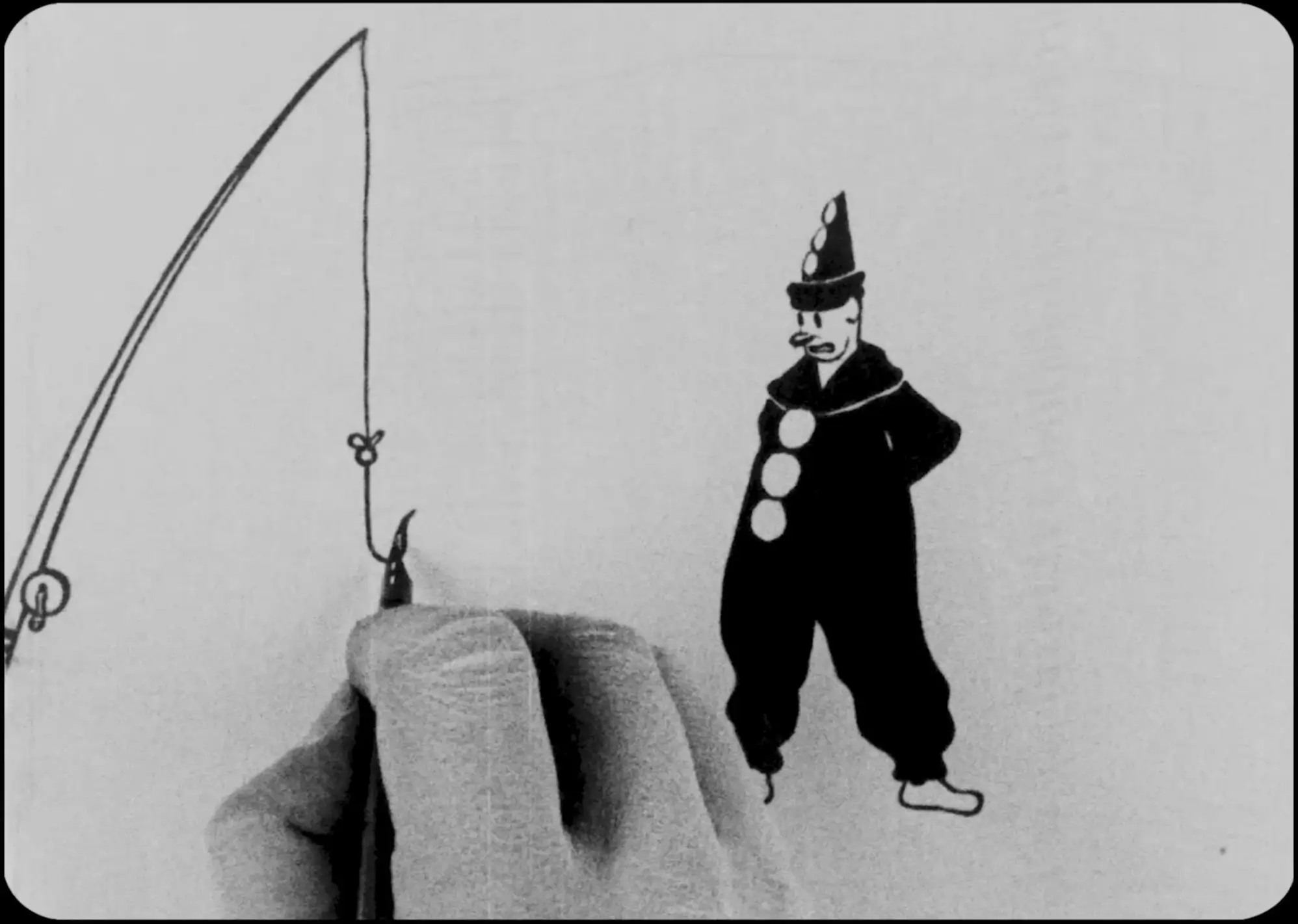
Fishing (1921)
Out of the Inkwell Films (USA)
Directed by Dave Fleischer. Produced by and starring Max Flesicher.
Restoration by Tommy J. Stathes. Some footage provided by the Library of Congress Motion Picture, Broadcasting & Recorded Sound Division.
Print courtesy of Cartoons on Film.
Accompaniment
Andrea Rackl, improvised piano
Synopsis
Max the cartoonist is distracted at the easel today: it’s time to go fishing! Koko the Clown wants to come along, but Max won’t let him. Left only with a tiny cartoon fishing pond (and some very odd daydreams), Koko decides he’s had enough – he climbs off the easel and goes in search of Max to get his prankful revenge!
“Mr. [Max] Fleischer's work, by its wit of conception and skill of execution, makes the general run of cartoons seem dull and crude.” – New York Times, 1919
About the film
Max and Dave Fleischer created some of the most iconic, best-made, and loopiest cartoons in history: Betty Boop, the original Popeye cartoons (1933-1941), and the Oscar-nominated Superman series (1941-1942) — and the amazing silent-era Koko the Clown shorts. Max’s technical innovations transformed the industry (and inspired notable imitators): rotoscoping, the first sound cartoons (years before Disney), the “follow the bouncing ball” technique for guiding audiences through sing-alongs, combining animation with live action (also well before Disney), and much more. And it all started with a mischievous clown.
When tonight’s cartoon was released, Koko the Clown didn’t have a name yet (that would come three years later), but he and his cartoons were already a bona fide worldwide hit. Creator and producer Max Fleischer (who appears as Koko’s foil in all of the cartoons) had just made the brave move of breaking with the biggest cartoon distributor of the time, who had given him his start in the business. This was the third cartoon made by the new Out of the Inkwell Films studio, and it was a sign of a bright future ahead.
Koko debuted in April 1919 (seven months before Felix the Cat), at a time when cartoon animation was extremely primitive and jerky. People loved the kooky sense of humor, but the jaw-dropping leap forward was the incredibly smooth and lifelike animation, unlike anything seen before.
That was thanks to Max’s invention called the Rotoscope, technology that is still used to this day (in digital form) in which a person is filmed performing, and then traced frame by frame onto animation cels.
Max was a brilliant artist, inventor, and self-trained engineer. At age 17, he began working as a news photographer and then editorial and strip cartoonist. After stints as an engraver and catalog artist for mechanical companies, Max landed the prestigious job of art editor for Popular Science Monthly. He used that job to finance the development of the Rotoscope, which he built and tested in the living room of his family’s small New York apartment. The work resulted in a test film based on Max’s brother Dave, filmed cavorting in a clown costume he wore working at Coney Island.
Max couldn’t find a backer until he bumped into John R. Bray, an old work friend who had co-invented the use of transparent cels for animation, and founded what had become the top animation studio in the world. Bray signed Max to a contract to produce his clown cartoons for inclusion in Bray’s monthly “screen magazine.” The cartoons were an instant hit.
The formula never varied, although no rendition of it was ever repeated. The live action Max draws and presides as the clown appears and then comes to life. The rambunctious clown causes trouble, usually by leaving the easel for the three-dimensional world, Max eventually prevails (often barely), and the clown retreats to the safety of the inkwell from which he sprang. Max and his team were New Yorkers through and through, and that humor's rough edges always shined through.
In 1921, Fleischer left Bray and created his own studio, taking the clown with him, continuing the series, and soon gracing him with a name. In 1924, Fleischer formed a company with inventor Lee de Forest to use his pioneering Phonofilm sound-on-film process to produce the Ko-Ko Song Car-Tunes series, animated sing-along shorts for which Max invented the “follow the bouncing ball” technique. Fleischer produced 38 Phonofilm sound cartoons between 1924-1927, all before Walt Disney's Steamboat Willie, which is usually cited as the first. The sound process had some success but never caught on, and was ultimately beaten out by Warner’s Vitaphone and Fox’s Movietone.
With or without sound, the Koko cartoons lasted through 1929, when various business machinations and the coming of sound both conspired to transform the Fleischer company and the cartoons they were making. In the future lay Betty Boop, Popeye the Sailor, Superman, two feature films, and eventual ruin as the result of a cutthroat ploy by Paramount to gain control of the hugely valuable Popeye cartoons.
Learn more about Fishing, the Fleischer brothers, and early cartoon history
- “Koko!” by Leonard Maltin – A wonderful essay written for the 2025 San Francisco Silent Film Festival’s program booklet.
- “The Search for Koko the Clown” by Ray Pointer (Traditional Animation, June 8, 2014) – Ray, one of the top Fleischer scholars, uses his own efforts to find and preserve Koko the Clown cartoons as a way to tell their history.
- “Song Car-Tunes 1924-1927” by James Mahoney (Fleischer AllStars, 2020) – The Fleischers produced the very first sound cartoons, years before Disney did. This article gives an overview of those 38 pioneering shorts for the De Forest Phonofilm company.
- Out of the Inkwell: Max Fleischer and the Animation Revolution by Richard Fleischer (University Press of Kentucky, 2005) – A slim but informative and charming biography of Max by his son, who is a major Hollywood director himself.
- The Art and Inventions of Max Fleischer: American Animation Pioneer by Ray Pointer (McFarland, 2017) – An in-depth look at Max’s life and work, and the history of the studio that bore his name, with previously unpublished artwork and photographs.
- Of Mice and Magic: A History of American Animated Cartoons by Leonard Maltin (Revised & updated edition: Plume, 1987. First ed: McGraw Hill, 1980.) – One of the best and most approachable histories from the silent era through the classic era. Lots of photos and art.
- Before Mickey: The Animated Film 1898-1928 by Donald Crafton (Univ. of Chicago Press, 1993) – Considered the standard history of silent era cartoon animation, although focuses primarily on the United States. Publisher’s webpage. | Find a used copy.
Home video
- Cartoon Roots: Back to the Inkwell (Cartoons on Film, 2026) Blu-ray + DVD – 15 newly restored early silent-era Koko cartoons by the Fleischer brothers, 1919-1922. Plus bonus material.
- Fleischer Cartoons – Greatest Hits, Volume 1 (ClassicFlix, 2026) Blu-ray – 20 newly restored Fleischer cartoons from the silent and sound eras, 1923-1941, from several series: Koko, Betty Boop, Superman, Popeye, and Color Classics. Plus bonus material.
- Fleischer Rarities: Treasures from the Fleischer Studios (Thunderbean Animation, 2018) Blu-ray – For the true Fleischer fans, this release includes favorites and extremely rare cartoons made 1920-1944, many from the only-known existing 35mm and 16mm prints. Lots of amazing extras, too.
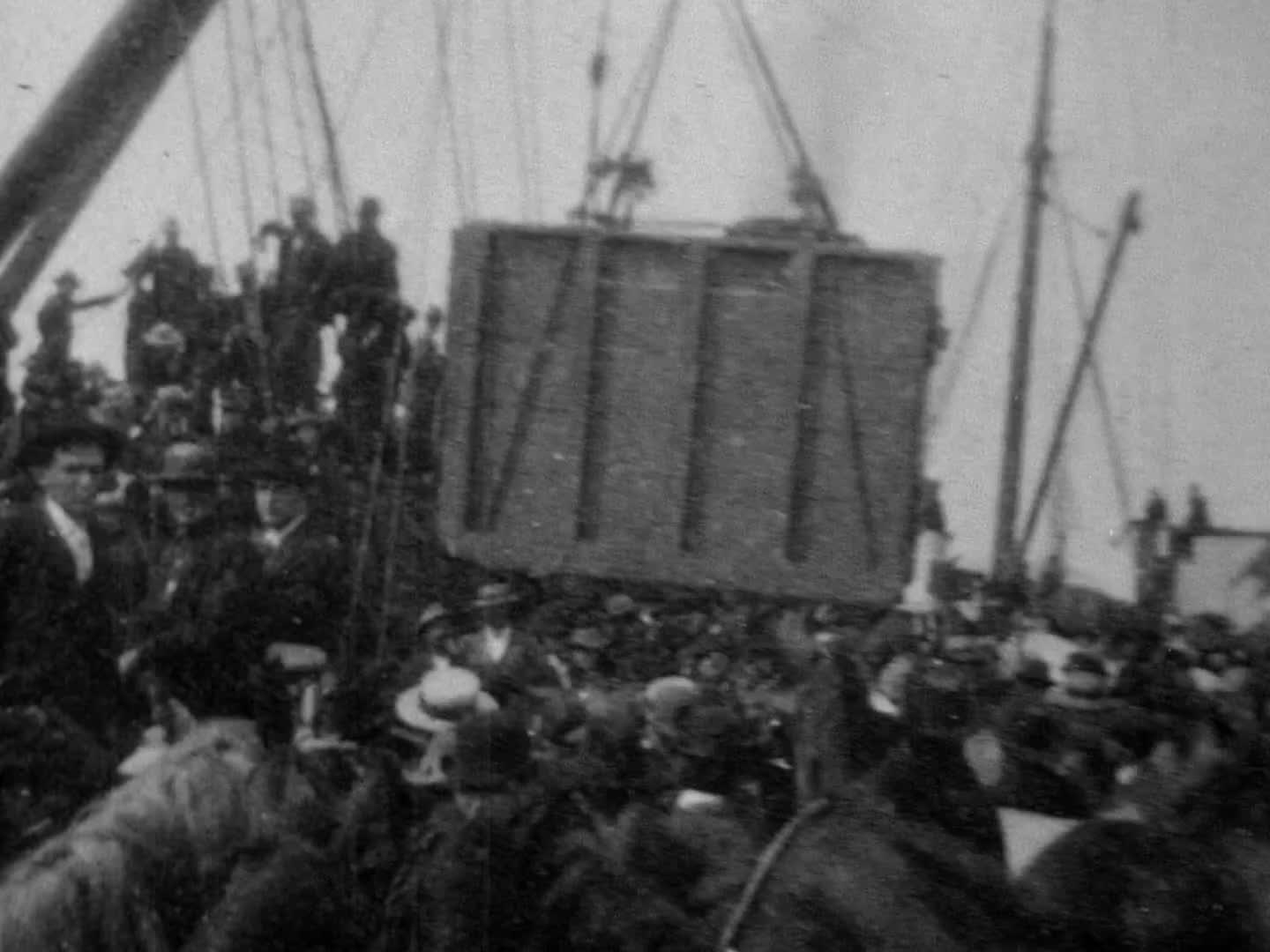
Scenes from Gold Rush Seattle (1897)
Edison Film Company (USA)
Footage preserved in the Paper Print Collection of the Library of Congress. Digitized by the Library of Congress Motion Picture, Broadcasting and Recorded Sound Division.
Compiled by Spencer Sundell.
Films courtesy of the Library of Congress.
Accompaniment
Andrea Rackl, improvised piano
Synopsis
Five short actuality films shot by an Edison crew on and near the Seattle waterfront between August 6-9, 1897, just three weeks into the Klondike Gold Rush. These are the earliest known surviving films of the Pacific Northwest.
“The picture shows the excitement and enthusiasm that attended the great Klondike exodus. Crowds of anxious gold seekers watch the loading of their outfits, clothing, kits and provisions…” – Edison film catalog
Films included
All films are from the Paper Print Collection of the Library of Congress, which preserved and digitized them.
First Avenue, Seattle, Washington — Filmed ca. Aug. 6-9, 1897. Originally listed (inaccurately) in the Edison film catalog as being a view of Fifth Ave. The camera is looking north on First Avenue, just below Yesler Way. In the right foreground is a sign for Cooper & Levy, one of the largest outfitters in town. Thanks to being only two blocks from the main pier for shipping out to Alaska, it was also the busiest.
S.S. 'Queen' loading (aka Steamship 'Queen' loading) — Filmed Aug. 6, 1897 at the Pacific Coast Steamship Co. dock, between S. Washington St. and S. Jackson St., where Pier 48 is today. Built in 1882, the Queen (originally named Queen of the Pacific) was 336 feet long, iron-hulled, had three decks, and could carry over 300 passengers. She was scrapped in 1935.
Loading baggage for Klondike, no. 6 — Filmed Aug. 6, 1897. Another view of the S.S. Queen taking on cargo. The original Edison film catalog falsely claimed this was the first ship to sail from Seattle for the Klondike gold rush. It also misidentified the ship as the SS "Williamette," which is both the wrong ship and a misspelling of Willamette (as in the valley in Oregon). Seen passing through the crowd is a coach from the Rainier Grand Hotel, Seattle’s premier tourist hotel at the time, located a half block from the waterfront. It was torn down in 1930.
Horses loading for Klondike, no. 9 — Filmed Aug. 7, 1897. Horses in large wooden open-top crates are hoisted on board by the ship’s derrick. The Edison film catalog claimed this footage was shot 10 minutes prior to departure. The ship appears to be the S.S. Willamette (referred to above). If so, this was filmed at the Pacific Coast Steamship Co. dock. It would also mean the filming date was probably actually Aug. 9.
S.S. 'Williamette' leaving for Klondike (aka Steamship 'Williamette' leaving for Klondike) — Filmed Aug. 9, 1897 at the Pacific Coast Steamship Co. dock. Here again, the ship was actually named the Willamett. The sailing date is confirmed by records in the Univ. of Washington Libraries Special Collections division, which include a photograph taken by George H. Braas (and later copied by Asahel Curtis) showing the Willamette loading on that day.
About the films
These are known as “actuality” films – what we perhaps might consider ultra-short vérité documentaries. They were very short, single-shot views of real-world scenes and events, or sometimes portions of a circus or stage act. In the first years of cinema, from 1894 to about 1900, nearly all movies were like this. The mere existence of pictures that moved and showed places and people we might never otherwise see was enough to entertain and marvel.
These earliest movies usually ran the length of a single spool of film, typically about 50 feet. There was no editing as we understand it. Cameras and projectors had no motors and were cranked by hand. Depending on the operator, a single reel would usually last between 20 and 30 seconds.
These Seattle views were shot as part of an Edison expedition to film locations on the West Coast for the first time. The Northern Pacific Railway provided financial backing and transportation for producer James H. White and cameraman Fred W. Blechynden, who also shot views in San Francisco, Los Angeles, San Diego, Denver, and in the wilds outside Portland, OR.
White and Blechynden later extended their expedition, embarking by train for Mexico and then by sail to the Hawaiian islands and the Far East. The pair shot footage in Yokohama and Nagasaki in Japan; Hong Kong; Shanghai, Canton (now Guangzhou) in China; and the then-Portuguese colony Macao. Some 25 films were eventually released from the Far East expedition alone.
Preserved on paper
These particular films were among those preserved thanks to the Paper Print Film Collection of the Library of Congress. In the early years, copyright law did not cover motion pictures, but it did cover photographs. So in order to copyright their most valuable movies, studios like Edison, Biograph, Méliès, and others made prints of them onto unbroken strips of photographic paper and submitted them as a single (very long!) photograph. Simply using paper instead of celluloid was enough to satisfy the copyright office. Tonight's films were among the first to be copyrighted in this fashion.
This practice ended in 1912 when the law was updated to include copyright for movies. But the happy side effect was that many of the earliest films were preserved as paper prints long after the originals and their negatives had decayed or been destroyed. Over 3,000 motion pictures of all kinds and from around the world are in the Paper Print Collection, many of them the only surviving copies. Over the years the Library of Congress has refilmed and digitized them, making them available to the world.
Learn more about early cinema, actualities, and early cinema in the Pacific Northwest
- “James H. White & Frederick Blechynden” – A three part series of articles about White & Blechynden’ west coast actualities, by “Paghat the Ratgirl” (a nom de plume of award winning fantasy author Jessica Amanda Salmonson):
- Northwest Picture Show by Eric L. Flom (2025 to present) – An ever-growing book-as-website that is the only detailed history of early cinema in the Pacific Northwest. See especially chapter 1: First Frames: Moving Pictures Arrive in the Northwest.
- Before the Nickelodeon: Edwin S. Porter and the Edison Manufacturing Company by Charles Musser (Univ. of California Press, 1991) – An in-depth look at one of the most formative periods in cinema history, from the earliest days of commercial motion pictures through 1909. The beginning of chapter 5 details the White and Blechynden west coast expedition. Free online @ California Digital Library | Buy e-book | Find copies to buy
- The Emergence of Cinema: The American Screen to 1907 by Charles Musser (Univ. of California Press, 1994) – The origins of motion picture technologies are described and analyzed in this lavishly illustrated volume that considers social and economic as well as aesthetic aspects of the beginnings of movie making. Publisher’s webpage | Find copies to buy
Streaming video
- American Artifacts Preview: Early Motion Pictures - Library of Congress "Paper Prints" (C-SPAN, 2013) 6 min. – Mike Mashon, then the head of the Motion Picture Section of the Library of Congress, explains the Paper Print Collection and how it came to be. Example clips are included.
- Reclaiming American History From Paper Rolls by the Renovare Process (Primrose Productions, 1953) 19 min. – A detailed look at the extremely involved technical process of rephotographing paper prints onto 16mm film. Directed by Kemp Niver, the cinematographer and film historian who developed the process and supervised the massive project, winning an honorary Oscar for his work.
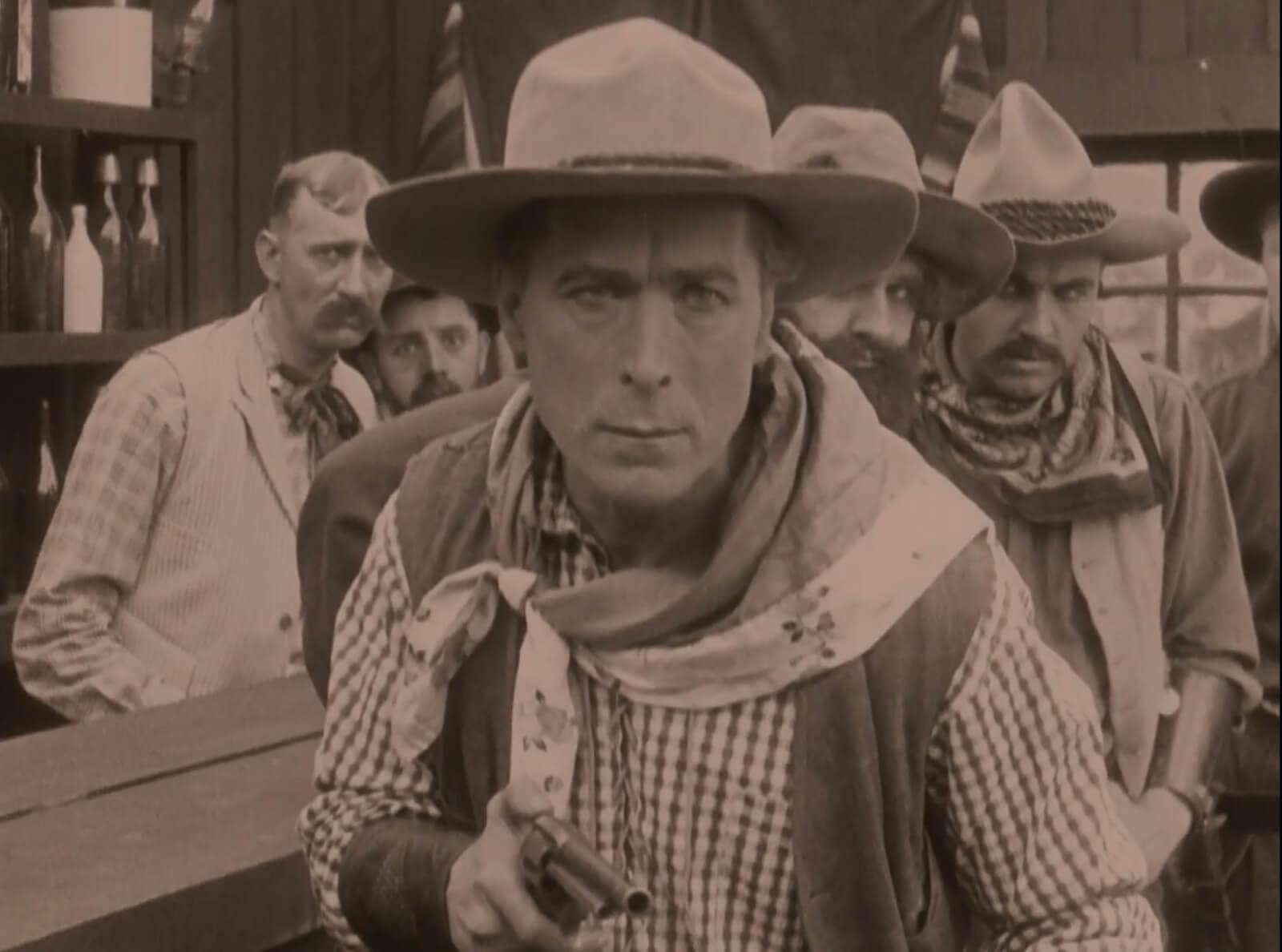
Bad Buck from Santa Ynez (1915)
Kay-Bee Pictures (USA). This version is a 1924 re-issue by Tri-Stone Pictures.
Directed by William S. Hart.
Written by J.G. Hawks and Thomas Ince.
Produced by Thomas Ince.
Cast: William S. Hart ("Bad Buck" Peters), Fanny Midgley (Mary Gail), Thelma Salter (Little Honey Gail), and Bob Kortman.
Scanned and restored in 4K resolution from a two reel 35mm nitrate print preserved at the Library of Congress.
Print courtesy of the Film Preservation Society.
Accompaniment
Original film score by Julia Zuzanna Sokolowska, composer.
Performed by the BSO Chamber Orchestra, Ryan Dudenbostel conducting.
Synopsis
Hell-raising outlaw “Bad Buck” Peters finally goes too far with the Sheriff of Santa Ynez. Fleeing for his life with a posse hot on his trail, Buck comes upon a widow and her little girl in desperate need. Despite the danger, he stops to help them. Then, rather than escape he stays in hiding nearby to keep a protective eye over them. When the child is injured, Buck risks everything to save her in a climactic race against time.
“A fine example of Western realism. ...A strongly realistic number.” – review in Moving Picture World, May, 22, 1915
About the film
Just one year into his movie career, this was William S. Hart's 14th film and he was already one of the biggest movie stars in the US. Under producer Thomas Ince, he was also directing his own films, which skillfully blended western adventure and classic melodrama with a groundbreaking stoic realism that paradoxically amplified the stories' sentimental underpinnings.
Hart’s trademark was the Good Bad Man, an outlaw who underwent moral reformation of a kind, yet stayed outside the law. His acting was surprisingly modern — comparatively understated, stoic and sincere, moving past many of the stagey tropes common at the time, even when he was going all-in on the sentiment. Audiences loved it, and at the peak of his career in the 1920s he was the box office rival of Charlie Chaplin, Mary Pickford, and Douglas Fairbanks.
Hart was born in 1865 in Newburgh, NY, about 60 miles up the Hudson River from New York City. He spent his formative years traveling with his family as his father roamed the still-rugged Midwest and frontier West installing grist mill gear in remote towns. Young Willie played with Minneconjou and Lakota children, lived briefly in the South Dakota Badlands, experienced the Kansas cattle depots, and once spent a week riding along with a cattle drive. But by age 13 he and his family moved back to New York.
As a young man, Hart developed an interest in theater (a disreputable profession in those days) and eventually joined the legion of struggling actors based in New York City and working touring shows. Gradually he was able to make a modest living, supporting his mother and family after the death of his father.
In 1905, the role of villainous Cash Hawkins in a Broadway production of the cowboy western The Squaw Man would change his life. Hart drew on his childhood experience in the West and effectively became the show’s resident expert and prop master. His portrayal and the show were a hit, running for two years. The cowboy persona revived his career, and similar roles followed for several more years until the movies began draining theater audiences.
By his own account, one day Hart saw what passed as one of the better nickelodeon Westerns and was appalled by the silly, unrealistic portrayal. If this junk was so popular, he figured something more true to life would be huge. He set out for California, where he knew old theater colleagues involved in the emerging filmmaking industry there.
One of those old actor friends was Thomas Ince, now a producer and boss for the New York Motion Picture Co. who was supervising the creation of what became a huge, pioneering studio and ranch devoted mainly to westerns. Ince signed a contract with Hart to direct and act in films following Hart’s concept of westerns made as realistically as possible. Ince’s sprawling film ranch, with its authentic frontier standing sets and rugged hill countryside, provided the perfect place to do it.
Hart was 49 years old.
The results were instant stardom for Hart, huge profits for Ince, and the best westerns of the silent era. Initially Hart made two-reelers, movies roughly 20 to 30 minutes long that were a very popular format at the time. Within a year of Bad Buck of Santa Ynez, Hart transitioned from two-reelers to feature films. His shorts continued to be re-released (often with new titles) throughout the 1920s, just as this one was.
Hart retired from the movies in 1925, as audience tastes were evolving to flashier stars like Tom Mix – and his own age was advancing. His last film was the self-produced Tumbleweeds, an epic depiction of the Oklahoma land rush of 1893. During his 11 year film career, Hart made about 20 shorts and nearly 50 features. He laid the groundwork taken up by later iconic Western figures from John Ford to Clint Eastwood, and his influence continues to be felt today.
To date, two of Hart’s films have been added to the National FIlm Registry: The Bargain (1914) and Hell’s Hinges (1916). Currently, the George Eastman Museum is leading a worldwide effort to restore as many of Hart’s films as possible. Tonight’s film is just one result of this multiyear project.
Learn more about William S. Hart and silent westerns
- The Complete Films of William S. Hart: A Pictorial Record by Diane Kaiser Koszarski (Dover, 1980) — Still the best book about Hart and his films. Begins with a short but thorough biography, and the rest is a chronological review of all his movies (1914-1925). Lots of photos, credits, etc. Read for free on Archive.org (login to borrow) | Find copies to buy.
- My Life East and West by William S. Hart (Houghton Mifflin, 1929. Reissued: R.R. Donnelly & Sons, 1994) — Hart’s autobiography. In the style of the time, he avoids discussing his personal life, but there is still much to learn about and enjoy here. Read for free at Archive.org.
- William S. Hart: Projecting the American West by Ronald L. Davis (Univ. of Oklahoma Press, 2003. Paperback edition: OU Press, 2020) — The only full length biography of Hart, drawing on Hart’s papers and much original research. Publisher’s webpage. | Find copies to buy.
- Thomas Ince: Hollywood's Independent Pioneer by Brian Taves (University Press of Kentucky, 2012) – The biography of the singularly important film producer and studio boss, written by a former film archivist for the Library of Congress. Publisher’s webpage. | Find copies to buy.
- William S. Hart Park and Museum (Santa Clarita, CA) – When visiting Santa Clarita, CA, visit Hart’s home and estate in the Newhall area, which he willed to be used as a public park and museum.
- The Invention of the Western Film: A Cultural History of the Genre’s First Half-Century by Scott Simmon (Cambridge University Press, 2003. Reprinted 2007.) — Covers the evolution of the western film genre from the birth of movies through the 1940s, while also drawing on literature, visual arts, social history, and legend. Publisher’s webpage. | Find copies to buy.
Home video and streaming
- Hell’s Hinges (1916) — Free streaming video of one of Hart’s best and most famous feature films, with piano accompaniment and film notes. Presented by the National Film Preservation Foundation.
- Wolf Lowry (1917) (Film Preservation Society, 2023) Blu-ray — The William S. Hart feature, plus Bad Buck of Santa Ynez and The Sheriff’s Baby (D.W. Griffith, 1913). Read a review.
- Amazing Tales Online: Restoring the Films of William S. Hart (San Francisco Silent Film Festival, 2022) — Free hour-long video presentation about a multi-year effort to restore nine Hart westerns, drawing on prints held by archives around the world. With George Eastman Museum Senior Curator Peter Bagrov and Preservation Manager Anthony L’Abbate. Description of the presentation.
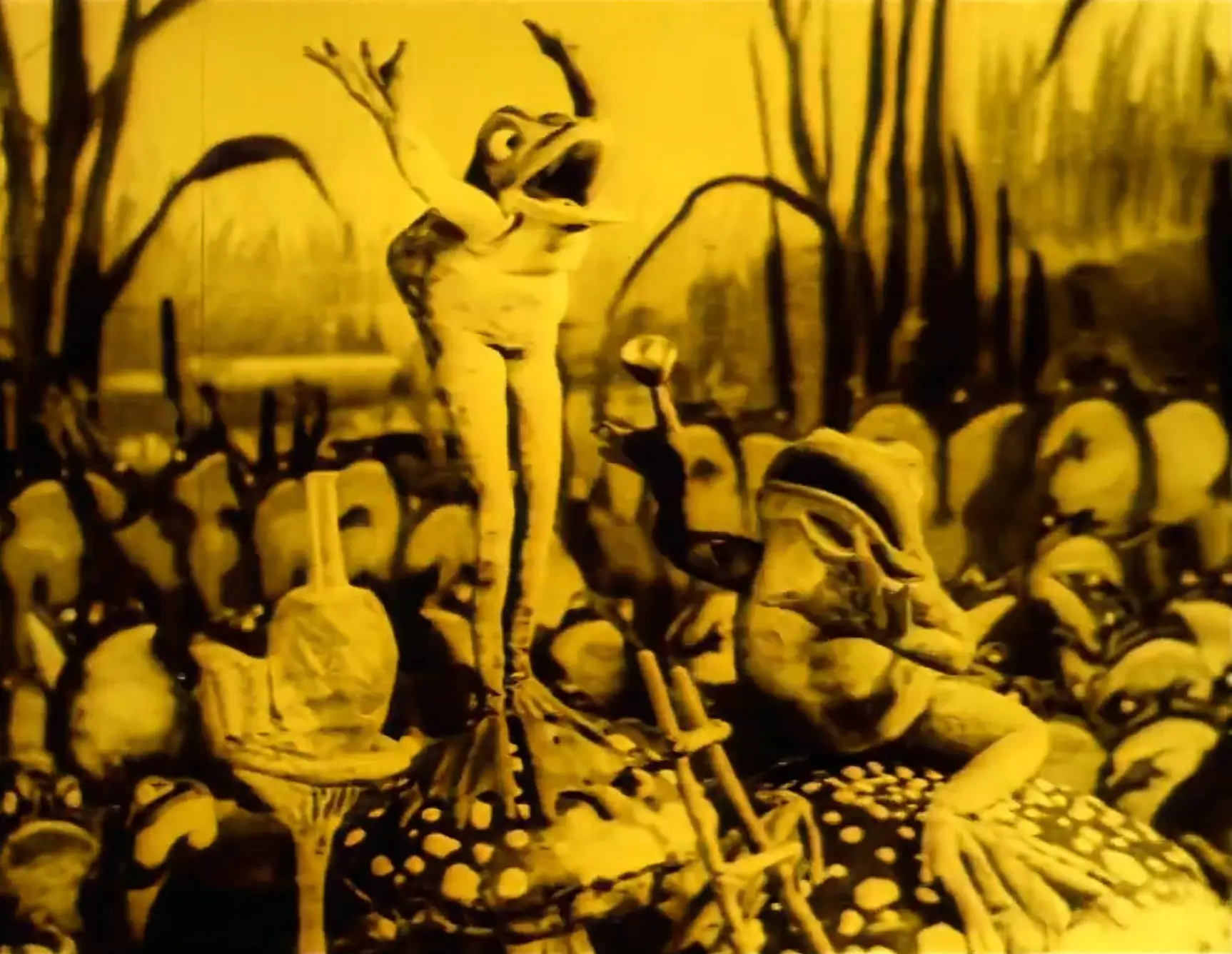
The Frogs Who Wanted a King (1922)
Les Grenouilles qui demandent un Roi
aka Frogland
Polichinei-Film (France). Released in the US by the Fox FIlm Corp. in 1924.
Directed and animated by Ladislas Starevich (Władysław Starewicz).
In collaboration with Irène Starevich (Irina Starewicz) and Anna Zimmerman.
Written by Ladislas Starevich, based on La Fontaine’s version of Aesop’s fable.
Accompaniment
Original film score by Kevin Woods, composer.
Performed by the BSO Chamber Orchestra, Ryan Dudenbostel conducting.
Synopsis
Frogland dislikes their king, and beseeches Jupiter for a new one. He obliges, but they don’t like that one either. More complaints from Frogland annoy Jupiter further, which really isn’t a very good idea. Based on La Fontaine’s adaptation of a fable by Aesop.
“A most unusual novelty. …The carefully constructed frogs and the colorful settings are indeed extraordinary… This is one of the best novelty numbers and well worth a place in your program.” – Film Daily (industry newspaper), Feb. 24, 1924
About the filmmaker
By whatever name – Władysław Starewicz (his Polish birth name), Владислав Александрович Старевич (the Russian rendition), Ladislas Starewitch (the spelling he adopted when living in France), or Ladislas Starevich (the most common English version) – he was one of the great, founding pioneers of stop motion animation.
All but forgotten until the 1980s and best known even today for one or two of his early films, produced in pre-Revolutionary Russia and featuring the peccadillos of animated insects, in fact Starevich was a prolific, inventive, and often surreal filmmaker who remained devoted to this demanding art form until the end of his life in 1965.
Born in Moscow in 1882 to ethnic Polish parents from present-day Lithuania, Starevich was a smart but undisciplined student with varied interests including painting, graphic arts, and insects. By age 28 in 1910, he had become the director of the Museum of National History in Kaunas, the capital city of Kovno (a Tsarist Russian region that is now Lithuania). He made a handful of documentaries for the museum about regional culture, and then wanted to make one about stag beetles. His first efforts to film a battle between two of the bugs failed, because the nocturnal insects stopped moving and then died under the bright movie lights.
One day, Starevich saw the film Les allumettes animées (The Animated Matches, 1908) by French animator Émile Cohl, one of the earliest pioneers of stop motion and drawn animation. Starevich studied the film, deduced how it was made by moving items very slightly and then photographed one frame at a time, and knew he had the solution to his problem. He put flexible wire armatures into hollowed out insect shells and made a film he titled Lucanus Cervus (1910), often considered to be the first animated puppet film.
The following year, he moved to Moscow to work at the film studio of producer Aleksandr Khanzhonkov. In the next seven years, he made over 30 stop motion animated shorts, often drawing on folk tales. These were immediate hits with audiences in Russia and abroad. The Grasshopper and the Ant (1913) earned Starevich a medal from Tsar Nicholas II, who became a fan and patron. Starevich’s most-remembered film was made during this time: The Cameraman's Revenge (1912), a cynical work about infidelity and jealousy among the insects.
Starevich’s support from the Tsar became a serious liability when revolution swept the country in 1917-18. He and his family fled the country and eventually wound up in Paris, which was rife with Russian exile artists and intellectuals of every type fleeing the Bolsheviks.
By 1920, Starevich was able to settle down and found a small animation studio in Fontenay-sous-Bois, a town just outside Paris, where he would remain for the rest of his life. He was able to earn a living making advertising and publicity films, which in turn financed his art. As film historian Eric Schneider explained, “The Parisian atmosphere was nurturing and supportive. Starevich often produced two or more films a year; his work growing in scope and content, and drawing heavily from children's literature.” During this period, his filmmaking also became a family affair, with his wife and daughters working on all of his productions.
In 1928, Starevich began adding sound to his films. In 1929-30, he made Le Roman de Renard (The Tale of the Fox), his only feature-length animated film. Now regarded as one of his finest works, it had a troubled release history which saw it linger in purgatory, only to then be badly recut and dubbed by various producers in various countries. (It has since been restored.)
In the 1930s he produced a series of films centered on a dog named Fétiche. These include another of his best-remembered masterpieces, Fétiche Mascotte (The Mascot, 1933), a 30 minute wild ride climaxing with a ball hosted by Satan himself, which influenced later filmmakers like Terry Gilliam and Wes Anderson.
World War II brought a halt to Starevich’s filmmaking until 1947, and while he continued to be active and win awards, he was never again as prolific as before the war. His last film was completed in 1958, the year his beloved wife Anna died. Seven years later, the elderly Starevich began work on a new film, but passed away before it was completed.
Other stop-motion animators of the silent era
- Émile Cohl – French caricaturist and proto-Surrealist turned “trick film” maker who made some of the very first animated films, including Fantasmagorie (1908), Les Joyeux Microbes (1909), The Bewitched Matches (1913), and many many others.
- Willis O’Brien – long before he created King Kong, he made shorts like The Dinosaur and the Missing Link (1915), Prehistoric Poultry (1916), and The Ghost of Slumber Mountain (1918), not to mention the original film version of The Lost World (1925).
- Tony Sarg – master puppeteer, illustrator, and creator of the giant balloons of Macy’s Thanksgiving Day parades, he made a series of animated films with paper cutouts called Tony Sarg's Almanac between 1921 and 1923.
- Lotte Reiniger – used stop-motion to animate exquisite paper cutouts in over 60 films, including the first feature-length animated film, The Adventures of Prince Achmed (1926).
- Charley Bowers – a newspaper cartoonist turned animator, he produced the Mutt and Jeff cartoon series and others before turning to truly bonkers independent short comedies in the 1920s that combined live action with inventive stop-motion animation.
Learn more about Ladislas Starevich and stop-motion animation
- Read the original Aesop’s fable — This webpage includes numerous translations and versions over the centuries, plus notes about its history.
- “Entomology and Animation: A Portrait of An Early Master Ladislaw Starewicz” by Eric Schneider (Animation World Magazine, issue 5.02, May 2000) — An excellent article examining the life and work of Starevich.
- Władysław Starewicz (Culture.pl / Adam Mickiewicz Institute, ca. 2018) — A short biographic article.
- “The Father of Stop-Motion Animation: A Secret Polish History” by Mikołaj Gliński (Culture.pl / Adam Mickiewicz Institute, 2019, rev. 2022) — Article covering the artist’s life and career, with rare photos and some embedded videos.
- “Love Among the Insects: The Pioneering Animation of Ladislaw Starewic” by Pat Keely (Bright Lights Film Journal, Jan. 31, 2010)
- A Century of Stop Motion Animation: From Méliès to Aardman by Ray Harryhausen and Tony Dalton (Watson-Guptill, 2008) – A coffee table book that is also the best history of the art form, co-authored by one of its all-time greatest artists. Profusely illustrated with stills, behind the scenes photos, and drawings. Out of print, but very highly recommended. Find copies to buy.
Home video
- The Cameraman’s Revenge and Other Fantastic Tales (Image Entertainment, 2000. Reissued 2005 and 2012) DVD — Includes six films, several with the original color tinting: The Cameraman’s Revenge (1912), The Insects’ Christmas (1913), The Frogs Who Wanted a King (1922), The Voice of the Nightingale (1923), The Mascot (1933) and Caroussel Boréal (1958). Out of print but available to rent from Film Is Truth, or used copies can be found to buy on the collectors market.
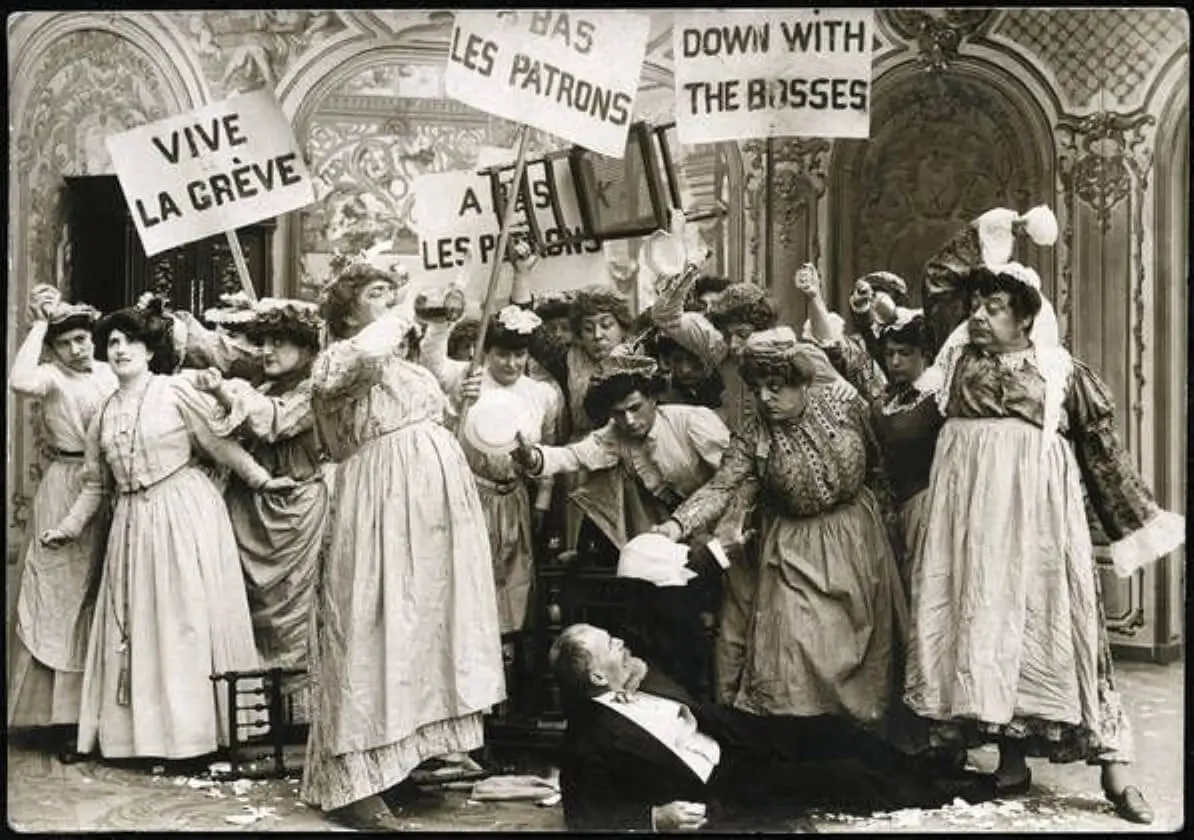
The Nursemaids’ Strike (1907)
La grève des nourrices
aka The Nurses’ Strike (US); Huelga de nodrizas (Argentina); Streik der Ammen (Germany)
Pathé Frères (France)
Directed by André Heuzé.
Digitized from a 35mm print held by Fondation Jérôme Seydoux-Pathé.
Print courtesy of Kino Lorber.
Accompaniment
Andrea Rackl, improvised piano
Synopsis
The nursemaids organize a general strike to protest their deplorable labor conditions. They march in the streets and clash violently with the police, who are no match for their collective feminist anger. Meanwhile, children organize a counter-protest and cow udders are enlisted as scab labor. Babies feed from cows through plastic tubes in the closing emblematic shot, which distills the film’s central message: another world is possible. - Maggie Hennefeld, Cinema's First Nasty Women
About the film and its makers
France is famous for its rowdy labor movements and frequent strikes but, as with much of the world, the years before World War I were particularly tumultuous. The period of 1906-1907 was a pivotal time, and The Nursemaids’ Strike was a satiric commentary on current events.
1907 was the first year that May Day was observed in Paris as an official public holiday. This came after a massive 1906 national May Day strike for an eight hour work day, a near revolution that lasted 19 days and ended with 60,000 troops confronting strikers and occupying Paris.
The resulting creation of a national Ministry of Labor and passage of a few pro-labor laws did little to quell the unrest, and strikes continued to bedevil the country. Electrical workers cut off all electricity to Paris (world renowned as the “City of Lights”), troops attacked a march for a guaranteed day off per week, thousands of waiters participated in the “Mustache Strike”, and protests by winegrowers in southern France exploded into a full-blown rebellion that nearly toppled the government when an entire regiment mutinied after troops fired into a crowd.
For French married women, 1907 was especially momentous because a national law granted them the right to manage their own wages and have their own bank accounts, and their earnings could no longer be seized to pay off a husband’s debts. (In the US, equivalent federal laws didn’t pass until 1974!)
Director André Heuzé (1880-1942) was a shopkeeper turned successful playwright of comedies and operettas. He hired on at the Pathé Frères studio in 1905. He worked primarily as a screenwriter, including a number of notable films with director Albert Capellani. But he also directed at least eight films between 1906-1916 – including tonight’s film. In 1910 Heuzé co-founded the company Le Film des Auteurs, and also worked to improve compensation for playwrights whose scripts were adapted to film. Though he largely retired from filmmaking after 1918, he edited and wrote for several film periodicals, and in the 1930s wrote a handful of screenplays. His first love was always the stage, and Heuzé continued to be an active playwright well into his later years. His son, also named André (b. 1913), had a brief career as a child actor in the 1920s, most notably in Julien Duvivier’s original Poil de carotte (Carrot Top) in 1925.
Pathé Frères, with their famous rooster logo, was one of the very biggest and most important movie companies in the early decades of cinema. Founded in 1896 as a spin-off of a successful phonograph company, by the early 1900s it had acquired the Lumière brothers’ patents, built advanced studio facilities, and become the world's largest film equipment and production company. They produced films in every genre, with high production values that were hard to rival and very popular with audiences around the world.
Their innovations were considerable. In 1903 they debuted Pathécolor, a groundbreaking stencil system that allowed the speedy mass-production of colored film. They invented the newsreel in 1908, pioneered movie serials, innovated early sound film experiments, created non-flamable film stock for the home viewing market, and introduced the system of renting film prints rather than selling them outright, as had been the norm. In 1906, Pathé opened a distribution office in the United States. Within just two years, they commanded 50% of the entire US market. WWI severely impacted the company’s interests, and it nearly folded. New ownership was able to revitalise the business, though it never again came close to the pervasive global reach of its early years. Pathé is still operating and successful today, making it the second oldest film company in the world (after Gaumont, founded in 1895).
Learn more about French silent comedies and Pathé Frères
- “The Rooster that Woke the World: The Pathé Brothers in Close-up” by Hazel Smith (France Today, June 17, 2019) – An article tracing the history of the legendary Pathé Frères studio, from 1896 to today.
- “Silents Are Golden: 12 French Silent Film Recommendations” by Lea Stans (CMH Blog, Oct. 19, 2023)
- The Ciné Goes to Town: French Cinema, 1896–1914 by Richard Abel (Univ. of California Press, 1998 revised edition) — Scholarly history of French cinema between 1896 and 1914, particularly during the years when Pathé Frères led the world in film production and distribution. Publisher’s webpage. | Find copies to buy.
- The Red Rooster Scare: Making Cinema American, 1900-1910 by Richard Abel (Univ. of California Press, 1999) – Examines the vital and pervasive role of Pathé and other French studios in the development of the American moviegoing market and culture, and the eventual backlash that resulted. Extremely rare period documents are reprinted in their entirety as part of each chapter. Fascinating and illuminating.
Home video
-
Cinema's First Nasty Women (Kino Lorber, 2022) 4x Blu-Ray or DVD box set — A marvelous, award-winning four disc set of 99 European and American silent films (over 14 hours), produced from 1898 to 1926. Genres include slapstick comedy, genteel farce, the trick film, cowboy melodrama, and adventure thriller. Includes commentary tracks and a lavishly illustrated booklet. Available on DVD or Blu-Ray (which has additional films).
- Free PDF download of the 114 page booklet
- Companion website for the box set by the Women Film Pioneers Project, which co-produced the set.
- The Max Linder Collection (Kino Lorber, 2014) DVD – Frenchman Max Linder was a film comedy pioneer considered by Chaplin himself to be “the great master.” Beginning in 1905 he made dozens of films as "Max", a wealthy and dapper man-about-town frequently in hot water because of his penchant for beautiful women and the good life. This DVD gathers three features and a short from his late career, when he was working in America, and includes some of his best work.
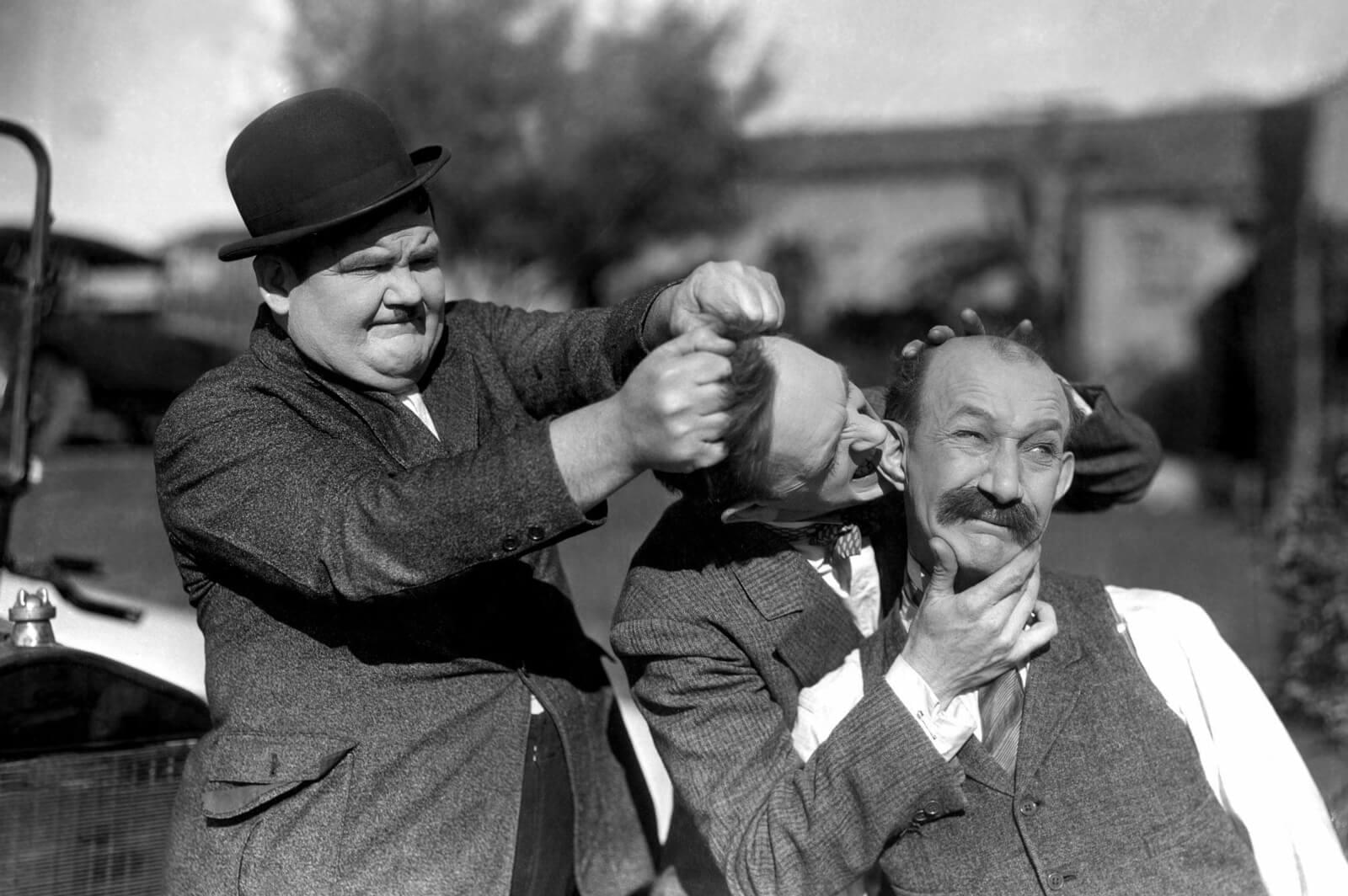
Big Business (1929)
Hal Roach Studios (Distributed by MGM)
Directed by J. Wesley Horne.
Supervised by Leo McCarey.
Written by H.M. Walker & Leo McCarey
With Stan Laurel, Oliver Hardy, James Finlayson, Tiny Sandford, Charlie Hall, & Lyle Tayo.
Restored by Blackhawk Films in 2025 from a 35mm safety dupe negative in the Library of Congress collection and a 35mm print in the Bruce Lawton collection.
Print courtesy of Flicker Alley.
Accompaniment
Original film score by Kevin Woods, composer.
Performed by the BSO Chamber Orchestra, Ryan Dudenbostel conducting.
Synopsis
Stan and Ollie are selling Christmas trees door to door. What could go wrong?
“The apotheosis of all Laurel & Hardy films... [T]he funniest two reels on film, Big Business is one of the comedy classics from any star, any country and any period.”
– William K. Everson, The Complete Films of Laurel & Hardy
About the film
It’s almost as if by smashing every last trace of the house and car, Laurel and Hardy were also stamping out the old ways of silent film – in one last glorious swan song – as they prepared to reinvent themselves for sound. Their first talkie, Unaccustomed As We Are, was released just two weeks later.
Big Business
was shot in eight days in December 1928, using locations in Los Angeles and Culver City, CA. The studio was in a hurry not only to wrap before the holiday, but because the studio was shutting down at the end of the month to retool for sound.A long-standing legend about the production is that the film crew showed up at the wrong address, and the studio had to pay off some poor soul for accidentally destroying his home. The true story is that producer Hal Roach had arranged with a studio employee to use his house while he was away on a trip. Rent would be paid and all damages repaired in full. But when the employee returned earlier than expected, he was shocked to discover the degree of utter devastation, and had to be calmed down. (It’s not clear whether the neighbors who endured six days of loud mayhem received any compensation!)
Stan Laurel and Oliver Hardy were only two years into their partner act, but the duo were already major stars. Laurel (born Arthur Stanley Jefferson in 1890) had started in British music halls, joining Fred Karno’s troupe in 1910, where he worked with Charlie Chaplin. Moving to the US in 1912, he toured the vaudeville circuit before making his first film appearance in 1917’s Nuts in May (only a fragment of which survives). He adopted his final stage name soon after. Laurel made comedies with various studios including Essanay and Universal, eventually settling in at Hal Roach Studios. In 1924, he quit the stage for full-time film work and by 1926 was also directing, writing, and working as a gag man.
Hardy was born in 1892. His given name was Norvell. He took Oliver as a stage name, but to friends and family he was always known as “Babe.” He first got into the business as a ticket taker and projectionist in his Georgia hometown. In 1913 he left town, hired on with the Lubin studio, and made his film debut the following year in Outwitting Dad (now lost). In 1924, Hardy signed with Roach who kept him quite busy. By 1927, he was a seasoned pro, having appeared in some 275 comedies.
As stock players at the Roach studio, Stan and Ollie appeared together in a few films. But it wasn’t until 1927 that director Leo McCarey suggested that the two become a comedy team. Their first film as a duo was The Second Hundred Years (1927), although some consider their first “official” team film to be Putting Pants on Philip (released two months later). They were an instant hit, and the rest is history.
Unlike many silent film performers, they not only gracefully made the transition to sound but became even bigger stars as a result. As arguably the greatest partner act in movie history, they made 107 films together, including 32 silent shorts and 23 feature films. Their last film together was in 1951. Big Business was inducted into the Library of Congress National Film Registry in 1992.
James Finlayson, the boys’ mustachioed nemesis in Big Business, was one of the greats of early film comedy. Born in Scotland, he abandoned tinsmithing for the stage. Emigrating to the US in 1911, he acted in Broadway and touring productions until moving to Los Angeles in 1916, where he got work with the L-KO Company and Thomas Ince. Finlayson signed on with Mack Sennett in 1919, who cast Finlayson as one of the original Keystone Kops. Hal Roach lured him away in 1922, and he spent most of the rest of his long career at that studio. Finlayson appeared in 33 Laurel and Hardy shorts and features (usually as a villainous foil), and dozens of other comedies with the likes of Charley Chase, Snub Pollard, Ben Turpin, and Our Gang. By the 1940s, he was relegated mainly to uncredited cameos, instantly recognizable thanks to his trademark walrus mustache. His last appearance was in the 1951 Fred Astaire musical Royal Wedding. He passed away in 1953.
Learn more about Laurel & Hardy and American silent comedy
- “Big Business” by Randy Skretvedt (National Film Preservation Board, 1992) PDF – An essay by the foremost Laurel & Hardy historian.
- The Complete Films of Laurel and Hardy by William K. Everson (Citadel Press, 1967. Re-issued numerous times.) – Plot summaries and critiques of all of their films, plus short bios and a lengthy introduction, written by one of the great pioneering film historians. Read for free on Archive.org (login to borrow) | Find copies to buy.
- Laurel and Hardy: The Magic Behind the Movies by Randy Skretvedt (Bonaventure Press, 2019. Previous editions: Moonstone Press, 1987; Last Gasp, 2015) — Everything you ever wanted to know about the team and all of their movies, written by the leading expert. Very large and profusely illustrated, it’s expensive but for true fans it’s well worth it. The earlier editions are much thinner and have far fewer photos. Order from the publisher. | Read the 1987 first edition for free on Archive.org (some info is out of date).
- The Silent Clowns by Walter Kerr (Knopf, 1975; Da Capo Press, 1980) – The go-to book to learn about the basic history of silent comedy in the US, covering “the big four” artists: Charlie Chaplin, Buster Keaton, Harold Lloyd and, of course, Laurel & Hardy. Read for free on Archive.org (login to borrow) | Find copies to buy
- A-Z of Silent Film Comedy: An Illustrated Companion by Glenn Mitchell (Batsford, 1998) – A slim but comprehensive encyclopedia, including international and lesser-known comedians and films that otherwise get ignored. A great starting point for those who want to enjoy more than the big four. Read for free on Archive.org (login to borrow) | Find copies to buy
Home video
- Laurel and Hardy: Year Three (Flicker Alley, 2025) 2x Blu-Ray set – Newly restored versions of all nine of their silent shorts from 1929 (including Big Business), among the very best they ever made. Plus many extras and a booklet.
-
Other releases in the same series, all with brand new restorations:
- Laurel and Hardy: Year One – 15 shorts from 1926-1927, plus extras.
- Laurel and Hardy: Year Two – 10 shorts from 1928, plus additional shorts and extras.
- Laurel or Hardy: Early Films of Stan Laurel and Oliver Hardy (Flicker Alley, 2021) 2x Blu-Ray set – New restorations of 35 rare comedies made before they teamed up together, sourced from archives around the world.
About the Composers
Andrea Rackl (Fishing, Scenes from Gold Rush Seattle, and The Nursemaids’ Strike) was the principal keyboardist for the Bellingham Symphony Orchestra for 28 years, beginning in 1998, and maintains an active career as a teacher, performer, improviser, arranger, and composer. She has been teaching privately for more than 30 years, and is active with the Washington State Music Teachers Association (WSMTA). As a pianist, Rackl has participated in countless solo and collaborative concerts over the years, performing locally in Bellingham House Concerts and with the Western Washington University Symphony Orchestra, and as far afield as Japan both as soloist and chamber musician.
Julia Zuzanna Sokolowska (Bad Buck of Santa Ynez) is a Los Angeles/Bellingham based composer, orchestrator, pianist, and multi-instrumentalist whose work bridges cinematic storytelling and orchestral craftsmanship. She holds a degree from Berklee College of Music and has built a career working across film, television, and media in both the US and internationally. Her credits include Netflix’s Filthy Rich, as well as The Book of Life (Warner), Beauty and The Beast (Disney), Empire (FOX), The Tonight Show with Jay Leno (NBC), The Whistle (PBS) and other narrative and documentary projects.
Kevin Woods (The Frogs Who Wanted a King and Big Business) is a trumpeter/composer who has emerged as one of the most emotive voices in improvised music in the Northwest. His passion for both performance and education have made him in demand as a leader and a sideman as well as a composer, arranger and clinician. Woods lives in Bellingham, Washington, where he is active as a performer, educator, author, composer/arranger, and serves as Professor of Music and Director of Jazz Studies at Western Washington University.
About the Musicians
Tonight’s films are accompanied by the BSO Chamber Orchestra:
- Guest Conductor: Ryan Dudenbostel
- Violin I: Dawn Posey
- Violin II: Lisa Humphrey
- Viola: Morgan Schwab
- Cello: Brian Coyne
- Bass: Mark Tomko
- Flute/Piccolo: Gena Mikkelsen
- Oboe: Gail Ridenour
- Bassoon: Phillip Thomas
- Trumpet: Karolyn Labes
- Percussion: Kay Reilly
- Harp: Jill Whitmas
Improvised piano: Andrea Rakl
About the Programmer
Tonight’s films were curated by Spencer Sundell, who also wrote the program notes. A resident of Seattle, he is co-founder and programmer for The Sprocket Society; a longtime staff member of the Grand Illusion Cinema, where he is currently Lead Projectionist and an assistant programmer; and a freelance projectionist providing support for film events, venues, festivals, and artists. Previously, he was a longtime projectionist at Northwest Film Forum, and in Chicago during the 1990s programmed occasional underground screenings including the Eyesore film series.
Tonight’s Sponsoring Organizations
Tonight’s program is part of the Bay Street Outdoor Cinema, the Pickford Film Center’s summer outdoor movie series. Thanks to partners Bellingham Symphony Orchestra, Brett McCandlis Brown & Conner, World’s Best Trivia, and Lombardi’s Italian Restaurant for providing event partnership, sponsorship, and entertainment before the show.
Downtown Activation with the City of Bellingham
Sunset Flicks is made possible by a grant from the City of Bellingham to activate downtown spaces. Learn more about this program and how the City of Bellingham is working to keep downtown Bellingham beautiful and vibrant and bring joy to our community.
Bellingham Symphony Orchestra
The Bellingham Symphony Orchestra is the resident orchestra of the historic Mount Baker Theatre. It performs seven concerts per season in addition to a variety of community and youth engagement programs across the calendar year. Details about the BSO and ticketing information for the current season are available at bellinghamsymphony.org.
Pickford Film Center
Pickford Film Center, a nonprofit organization, provides a forum and resource for independent cinema, strengthening community through education, dialogue and the celebration of film. Since its founding in 1998, it has been the only independent cinema, operating 365 days a year, between Seattle and Vancouver B.C. For more information and what’s playing, go to pickfordfilmcenter.org.